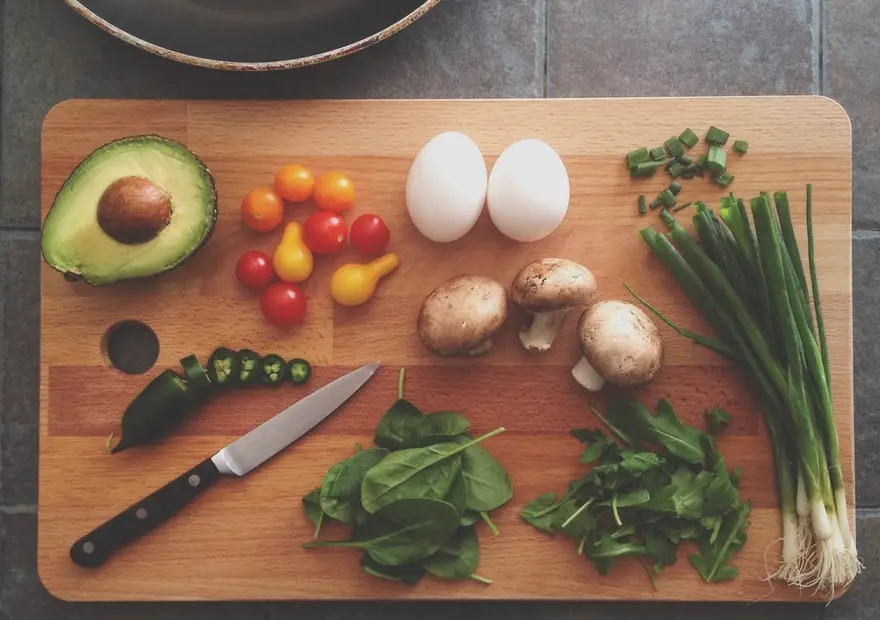
The avocado breaks the fruit pattern: its calories come from fat, not sugar, which is why it sits nearer the nuts than the apples in density. USDA prices it per fruit and per 100 g; the 'half an avocado' of café fame is roughly 80 g and about 128 kcal. Its fat is mostly monounsaturated, its fibre is genuinely high for a fruit, and its real counting risk is social — it arrives smeared, dolloped and 'just a bit extra' in quantities nobody weighs.
Avocado calories by portion
| Portion | Calories | Protein | Carbs | Fat | Fibre |
|---|---|---|---|---|---|
| 1 avocado (201 g) | 322 | 4.0 g | 17.1 g | 29.5 g | 13.5 g |
| 100 g | 160 | 2.0 g | 8.5 g | 14.7 g | 6.7 g |
| 1 oz (28 g) | 45 | 0.6 g | 2.4 g | 4.2 g | 1.9 g |
| 2 servings (402 g) | 644 | 8.0 g | 34.2 g | 59.0 g | 27.0 g |
One serving is 16.1% of a 2,000 kcal reference day. Sodium: 14 mg per serving (7 mg per 100 g).
Where avocado's calories come from
Of the energy in avocado, about 5% comes from protein, 20% from carbohydrate and 75% from fat (Atwater factors: 4, 4 and 9 kcal per gram). That split explains how the food behaves: fat-led foods are satisfying in small amounts and easy to over-serve. At 160 kcal per 100 g it sits in the moderate band of the food calorie chart, alongside the foods in the comparison below.
Where avocado sits in its group
Within the Fruits group of this database (33 foods), avocado ranks #29 of 33 by calorie density — the group runs from lemon at 29 kcal per 100 g up to coconut at 354, with a middle value around 52. That puts it on the heavier side of its group: a food to portion deliberately rather than serve freely. To log it alongside the rest of the day, open the free calorie counter and search “avocado” — servings or exact grams, both priced from this same USDA entry.
Avocado compared with similar foods
| Food (Fruits) | kcal / 100 g | kcal / serving |
|---|---|---|
| Avocado | 160 | 322 |
| Banana | 89 | 105 |
| Pomegranate | 83 | 72 |
| Fig | 74 | 37 |
| Fruit cocktail | 73 | 181 |
| Grapes | 67 | 62 |
Avocado questions
How many calories are in avocado per 100 g?
160 kcal per 100 g, from USDA FoodData Central entry “Avocados, raw, all commercial varieties” (FDC ID 171705). Per ounce (28 g) that is 45 kcal. The 100 g figure is the one to compare foods with — servings vary, density does not.
How many calories are in one serving of avocado?
322 kcal for 1 avocado (201 g) — about 16.1% of a 2,000 kcal day. That serving also gives 4.0 g protein, 17.1 g carbs, 29.5 g fat and 13.5 g fibre.
Is avocado good for weight loss?
It depends on the role it plays. At 160 kcal per 100 g, avocado counts as a moderate food, with 6.7 g of fibre and 2.0 g of protein per 100 g. Foods in this density range are the easy ones in a deficit — you can eat a satisfying amount before the calories become the story, especially when the rest of the plate is built deliberately. The note above puts its specific case.
How much protein, carbs and fat are in avocado?
Per 100 g: 2.0 g protein, 8.5 g carbohydrate and 14.7 g fat — which works out to roughly 5% of its energy from protein, 20% from carbs and 75% from fat (using 4/4/9 kcal per gram). Per serving (201 g): 4.0 g protein, 17.1 g carbs, 29.5 g fat.
Source: USDA FoodData Central (SR Legacy), “Avocados, raw, all commercial varieties”, FDC ID 171705 — public-domain US government data. Values are for the generic food as described; brands and preparations vary.